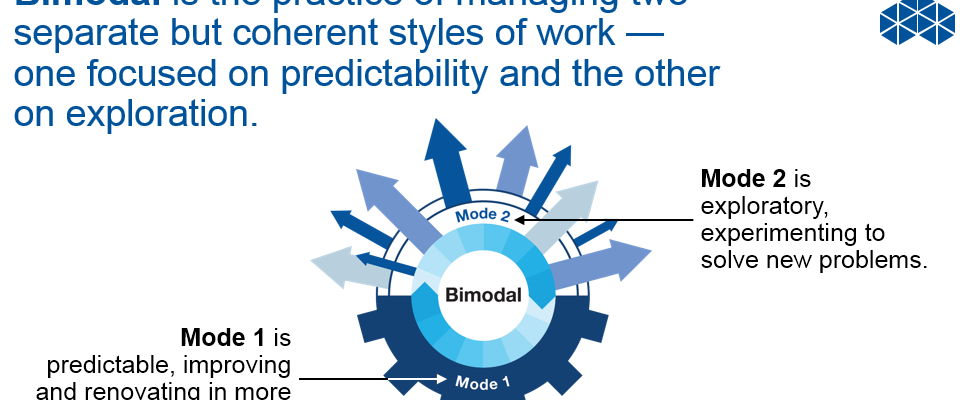
How to facilitate the dialogue for business led IT and how this complements the bi-modal IT idea
What is happening: Business Led IT is growing, business functions are procuring IT services and building their own facilities to support these services. Not always without risk. <more about business IT>
Why is this happening: The cause of this bypassing behaviour is that the value that the IT function can add is not always clear and the therefore The IT Function is often not seen as an enabler for achieving business goals.
What is the danger: A Business Functions may not always be aware the control and operate requirements and as a result unwillingly expose our organisation to undesired security and reliability risks.
What can we do: IT and business relation should shift to the partnership model and away from the internal supplier / customer model. IT people can advise the business functions on the operational governance that is needed to be able to provide secure and reliable operations and help design an operating model that covers the service end to end. This nicely fits in with the Gartner Bimodal IT ideas[1]. A service can start as mode 2 and gradually, seamlessly move over to mode 1 as it matures.
Operating model Variants
The key goal is to manage risk. Of course risk is acceptable, there is no perfect world but we need to ensure that risks and consequences are well understood, documented and accepted by the relevant stakeholders. The operating models below are there to help set a reference target state to work towards. Each indicates an ambition; they are not intended as a policy dictate.
Start with formulating an ambition:
- Aim for IT Operated — End to End Application & Infrastructure >> If end-to-end IT operations of an application service by the IT Function is desired.
- Aim for Business Operated —with IT Support for Technical Interfaces>> If IT support is desired for the technical interfaces of an application that has integration with the organisations other systems and where the Service Provider contract is Business Owned.
- Aim for IT and Business Operated – Customized operate model (mix & match) >> If a tailor-made operate model is required
| Reference Model A | Reference Model B | Reference Model C |
| IT Operated — End to End Application & Infrastructure | Business Operated —with IT Support for Technical Interfaces | IT and Business Operated – Customized operate model
(mix & match) |
|
|
|
Operating Models and their process accountability*
| Operating Model →
——————- Support Process ↓ |
IT Operated — End to End Application & Infrastructure | Business Operated —with IT Support for Technical Interfaces | IT and Business Operated – Customized operate model
(mix & match) |
||
| Application & Interface | Application | Interface | Application | Interface | |
| Request Mgmt | IT OPS | Business | IT OPS | t.b.d. | t.b.d. |
| Incident Mgmt | IT OPS | Business | IT OPS | t.b.d. | t.b.d. |
| Situation Mgmt | IT OPS | Business | IT OPS | t.b.d. | t.b.d. |
| Problem Mgmt | IT OPS | Business | IT OPS | t.b.d. | t.b.d. |
| Change Mgmt | IT OPS | Business | IT OPS | t.b.d. | t.b.d. |
| Enhancement Mgmt | IT Delivery | IT Delivery | IT Delivery | t.b.d. | t.b.d. |
| Release Mgmt | IT Delivery | IT Delivery | IT Delivery | t.b.d. | t.b.d. |
| Service Level Mgmt | IT OPS | Business | IT OPS | t.b.d. | t.b.d. |
| Configuration Mgmt | IT OPS | Business | IT OPS | t.b.d. | t.b.d. |
| Supportability & Transition Mgmt | IT OPS | t.b.d. | IT OPS | t.b.d. | t.b.d. |
| Business Continuity/ Disaster Recovery | IT OPS | Business | IT OPS | t.b.d. | t.b.d. |
| Software License Mgmt | IT OPS | Business | IT OPS | t.b.d. | t.b.d. |
| (Vendor) Contract Management | IT OPS | Business | IT OPS | t.b.d. | t.b.d. |
| IT Control Ownership & Execution | IT OPS | Business | IT OPS | t.b.d. | t.b.d. |
*Accountability means that the listed organization is end responsible for the operation and governance of the respective process. This does not per se mean that they are involved in the day to day operation of this process. Take incident management as an example. You can have a support model where this function is provided by a vendor and the Business is accountable. In this instance, we will utilize
the support desk of the vendor, however the responsibility for SLA performance remains with the Business. The Businesses responsible for managing performance and escalation, When the contracted vendor does not perform according to expectations the Business is on point to step in and resolve the situation.
How to start the dialogue
Start with establishing the operate ownership aspiration: IS the application solution to be operated by the IT Function? In this scenario:
- the IT function will take end-to-end accountability for the secure and reliable operations of the application service
- the IT function needs to be the contract holder for the IT elements of a service. This is necessary for the IT function to be in a position to effectively manage vendor’s contract performance
When the aspiration for the application service is to be business operated, make the expected benefits from this approach explicit and explore if these expectations can be validated.
Often a support model design session can help in discovering the areas of operate activities. It will help you gain insight on needed operational governance and identify the areas where the IT function can add value. Opsasto has facilitation material for such a session, look for “The Support Model Design Workshop” reader”.
- https://research.gartner.com/definition-whatis-bimodal?resId=3216217&srcId=1-816332510 ↑
[…] of the operate governance within the business. Often this is also a good workable approach for BiModalIT […]