In this article, we will cover the cutover plan, its purpose and provide guidance for the setting up the structure and agreement. The objective of the cutover period is to ensure the service that has gone in production fulfills the expectations of its users and that the organization can deliver the needed operational quality.
Start & Entry Criteria
The cutover period starts when the IT service starts to be used operationally (operational use of the system by a representative number of end-user). The project delivery organization remains accountable until the exit criteria have been met and service operations has accepted ownership. Entry criteria for the cutover period is the “Operational Readiness Confirmation” or ORC from IT Operations
Duration
As mentioned the objective of the cutover period is to assure user satisfaction and operational capability. Here counts: “the proof of the pudding is in the eating”, you cannot evaluate quality when something is not being used. So, we should allow sufficient time for all workflows to be completed. This also prevents the buildup of technical debt caused by undiscovered and unresolved issues.
Our advice is that the cutover period should include a minimum 2 full workflow cycles.
Examples:
- 2 weeks — when used daily and the workflow cycles are no longer then one week
- 10 weeks — when the workflow cycle duration is monthly
- 15 weeks — when the workflow cycle duration is quarterly
- For a yearly workflow cycle (for instance fiscal year end reporting) two full cycles is “a bit unpractical”. Try to find a “fit for purpose” solution.
In all cases make risk based decisions. The publication of the yearly earnings for a publicly trading company justifies larger investments than the Christmas time “pick your own present” app. How can you best assure user satisfaction and operational capability within justifiable efforts? With the yearly earnings report, you maybe should do a simulation with dummy data and you can arrange for a hyper care team to standby when the business cycle runs. For the Christmastime app, maybe you just accept the risk.
End
The cutover period ends when the agreed duration is completed or upon successful completion of the exit criteria, whichever is the later. Once the cutover period/exit criteria are completed successfully, the operational accountability can be handed over to IT Operations. The project delivery request an “Agreement to Take operational Ownership” or ATO
Exit Criteria
| # | Condition | Required Outcome |
| 1 | Conditions raised at ORC -or any new conditions raised after ORC- for reaching ATO are closed | Confirmation from IT Ops that the conditions raised have been closed |
| 2 | Positive verification Quality Requirements | Confirmation IT Ops on positive verification |
| 3 | Core functionality (critical tasks) of the application as agreed and identified is adequately exercised by a representative number of users | Confirmation from the Business Owner that a representative proportion (ex: 50%) of the user base is using the IT solution correctly as expected |
| 4 | All support teams are ready (have the budget, capacity and capability) and have demonstrated their ability to support the service without the help of project delivery | Confirmation from the IT OPS that the Support Model and Fulfillment Plan agreed for ORC are still valid and that all identified Support teams can support the IT solution without any further help from the project |
| 5 | The delivered functionality and associated interfaces are stable |
|
During the cutover period, we prevent project delivery discharging (all) skills and capacity without confirmation of a stable service. The exit criteria empower IT Ops to direct project delivery effort in order to ensure that IT Ops is able delivering the quality the organization needs. As with all things in Opsasto, the exit criteria are for guidance purposes and should not be used as a dictate. Key is managing the risk and being aware of the organizational long(er) term context. The lifecycle of a service stretches far after the point where the delivery project finishes.
Service cutover plan
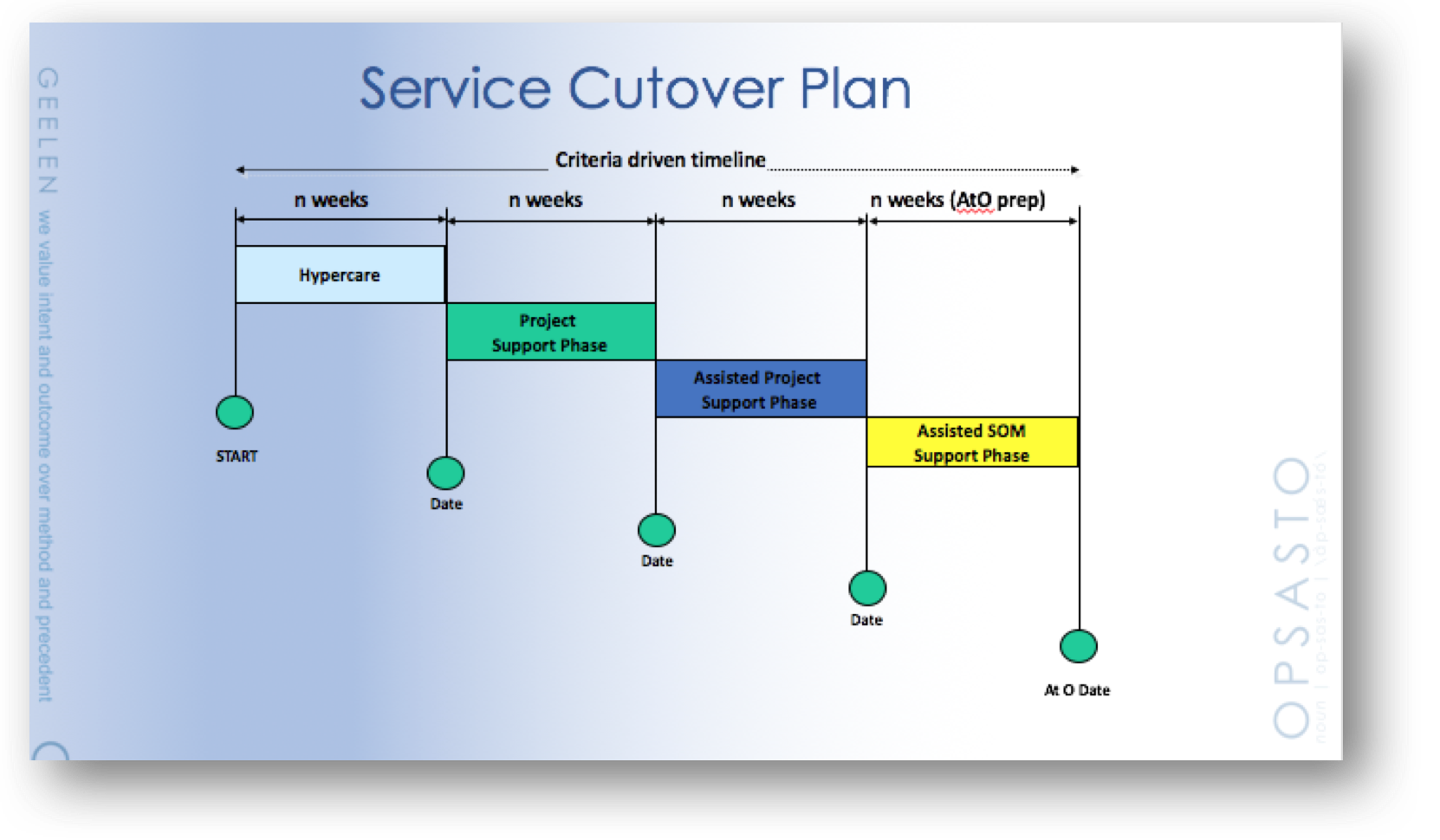
In some situations, one long cutover period leaves to much opportunity for misalignment occurring. This can be the case with large scale introductions that involves large and diverse user groups. You can choose to divide the cutover period in multiple phases and where with each next phase, you gradually move more of the operational activities to the IT Ops team.

Figure – Service Cutover Plan
Hypercare phase
| Entry Criteria |
|
| Operations Factors (examples given below – tailor for your project) |
|
| Exit Criteria (examples given below) |
|
| Anticipated Duration |
|
Project Support Phase
| Entry Criteria |
|
| Operations Factors (examples given below – tailor for your project) |
|
| Exit Criteria (examples given below) |
|
| Anticipated Duration |
|
Assisted Project Support Phase
| Entry Criteria |
|
| Operations Factors (examples given below – tailor for your project) |
|
| Exit Criteria (examples given below) |
|
| Anticipated Duration |
|
Assisted OPS Support Phase
| Entry Criteria |
|
| Operations Factors (examples given below – tailor for your project) |
|
| Exit Criteria (examples given below) |
|
| Anticipated Duration |
|
Interim process workflows during the phases
Maybe you will need to modify workflow for incident, change and request processes. It is generally a good idea to document and share these “interim” workflows.

Figure — Example Interim Process
Effective issue management in projects.


[…] Support cutover plan […]